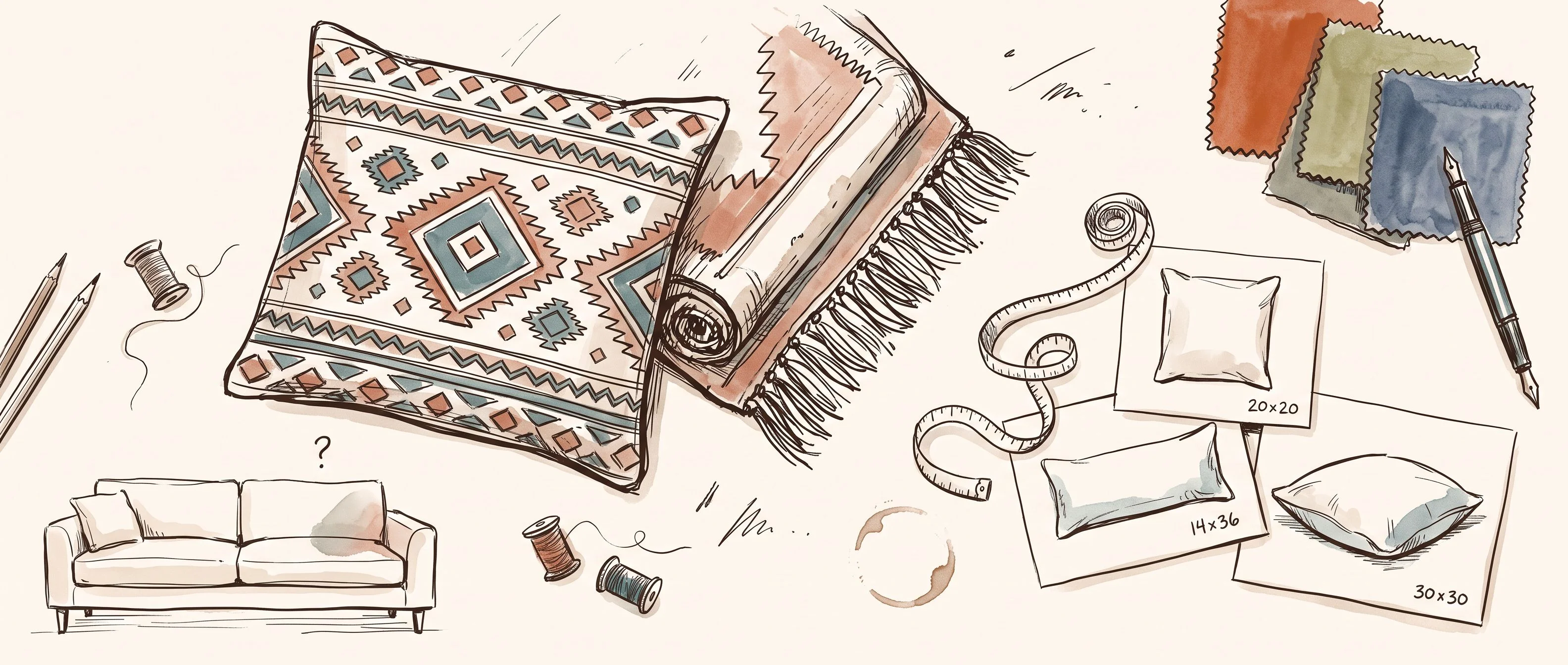
Most niche research starts with the product.
Kilim pillows. How many listings are there? What do they cost? Which tags do the bestsellers use?
Useful questions. But they miss the more interesting one.
What is the buyer actually trying to bring into the room?
Usually, it isn't a historically correct piece of flat-woven wool. It is warmth. Pattern. A little age. Something that makes a blank sofa look collected instead of recently delivered.
The word kilim is often shorthand for that whole feeling.
This is why one of the strongest listings in the niche is not made from an old kilim at all. It is a new, made-to-order chenille cover from Türkiye. It borrows the geometry and color language of a Turkish rug, then removes several things that make traditional rug pillows harder to buy: the coarse hand, the fixed dimensions, the one-off colorway, and the vintage price.
That compromise appears to have generated roughly $62,000 from this one listing. It performs like a 25x outlier inside its own shop and drives about a third of the shop's monthly revenue.
Appears to, because Etsy doesn't publish sales numbers for individual listings. Figures like these are modeled from what anyone can see: prices, review counts, favorites, badges. That's enough to spot an unusual performer and get a rough sense of its scale. It isn't the seller's books, and it isn't a promise of what another shop would earn.
The tempting conclusion is that kilim pillows sell.
The better conclusion is that there is money in separating an aesthetic from the inconveniences that usually come with it.
The buyer starts with the sofa
The search data for this listing is unusually revealing.
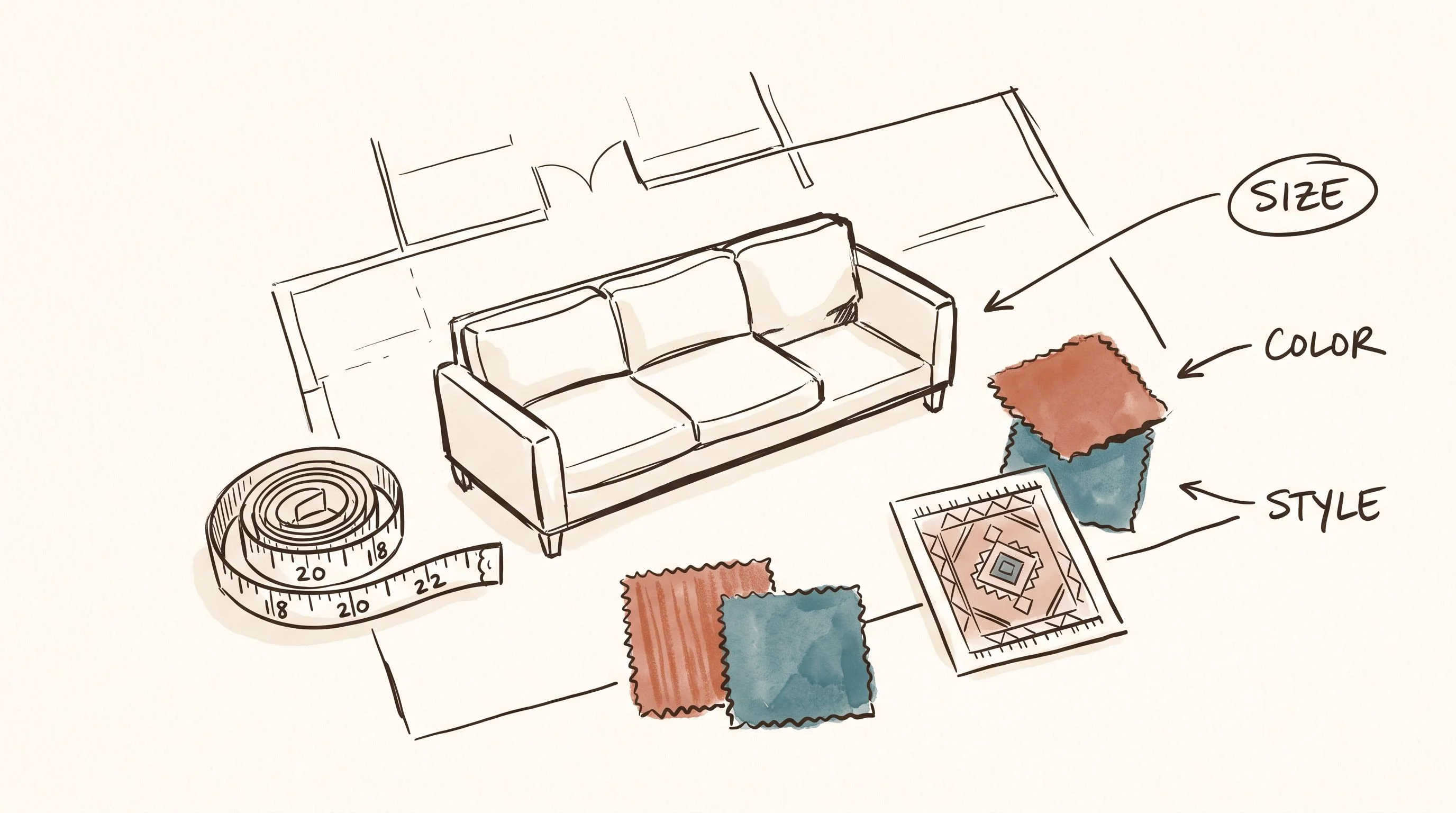
Its strongest tag is not "kilim pillow cover." That exact phrase averages about 120 views in the research tool used for this teardown. A tag made entirely of common dimensions ("18x18 20x20 22x22") averages more than 3,300.
"Burnt orange pillow" averages roughly 2,450.
In other words, the size tag is pulling about 28 times the views of the literal niche term. The color tag is pulling about 20 times as many.
That tells you how the buyer is approaching the purchase. She has an empty 20-inch insert on a cream sofa. Or a bench that needs one long lumbar cushion. Or an autumn palette with a dead spot in it. She may like the kilim look, but "kilim" is not the first constraint. The room is.
This is easy to forget when you sell a designed object. You think in motifs, influences, and products. The customer thinks in gaps.
She is not shopping for your pillow. She is trying to finish her sofa.
This niche is built around a trade
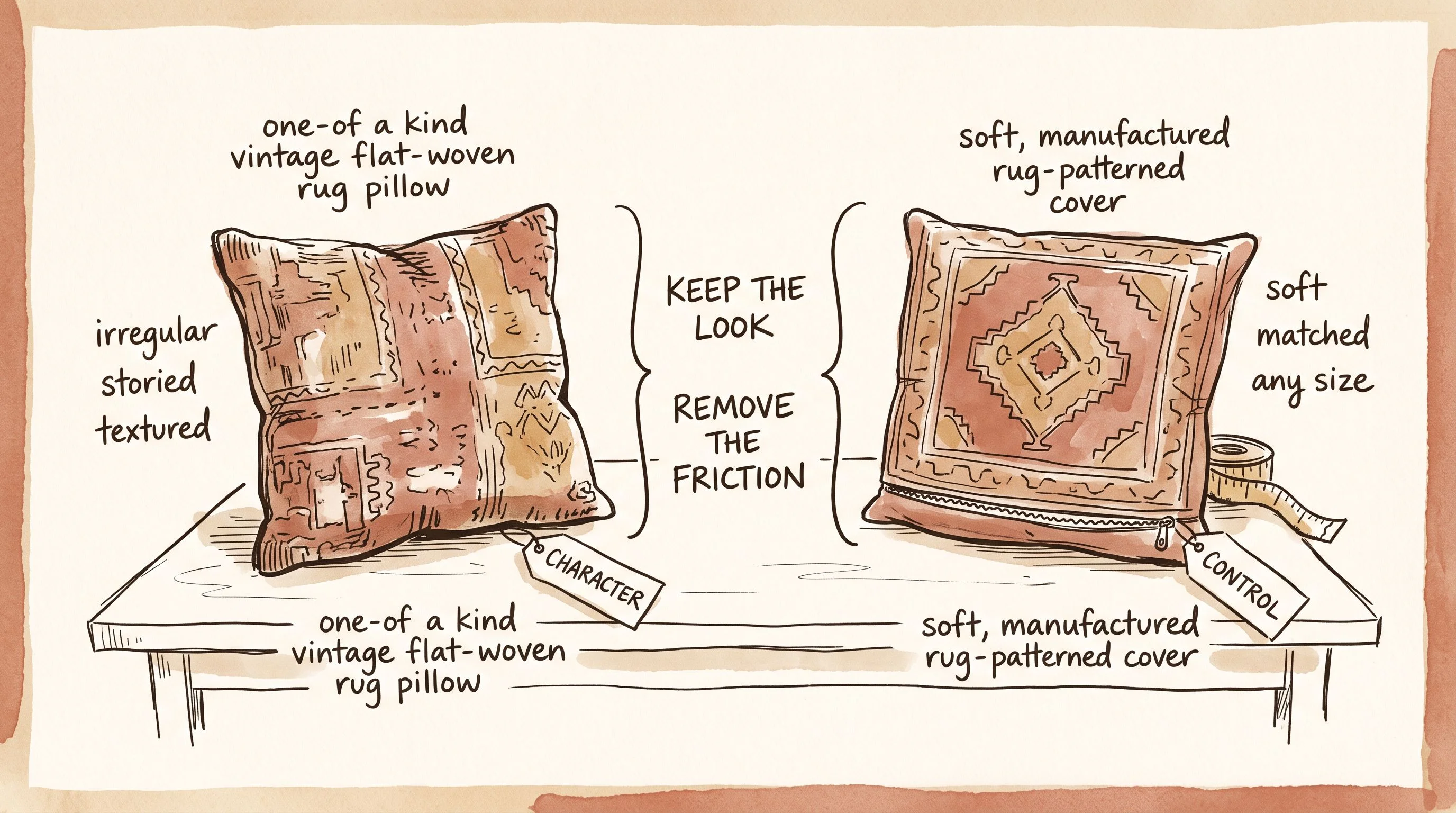
Traditional kilim pillows have real appeal. Each one carries the irregularities of the textile it came from. The wool has texture. The colors have history. No two cuts land exactly the same way.
Those strengths also create friction.
Old textiles come in the dimensions they come in. Wool can feel rough against bare skin. A particular red may look wonderful online and fight with everything in the buyer's house. Authentic pieces can be expensive, especially when someone wants a matched pair.
The chenille listing makes a very deliberate trade: less provenance, more control.
The pattern repeats. The fabric is soft. Two covers can match. The buyer can choose from 48 sizes, including squares, lumbars, bench lengths, and floor-pillow proportions. If none fits, the seller invites a custom request.
Even the product description leans directly into the compromise. It tells the buyer the cover does not have the hard texture found in other woven kilim covers. That line is not decorative copy. It is objection handling.
And the reviews reward it. "Soft" appears in Etsy's buyer highlights alongside "great quality," "as described," and "fast shipping." Nearly 300 item reviews hold a 4.9 average, and 97% of buyers recommend the product.
The opening, then, is not "make another kilim pillow." It is to decide which part of the traditional product your customer loves, which part she merely tolerates, and whether those two things can be uncoupled.
Keep the visual character. Remove a practical objection.
That is a much richer place to design from.
Forty-eight sizes are forty-eight reasons to buy
The listing appears in Etsy search at $20.40. That price belongs to the smallest 12x12 cover.
On those estimates, the implied average order value is closer to $51.
That gap matters. The low price earns attention, but the size menu captures intent. A buyer with a 20x20 insert is not going to squeeze it into a 12x12 cover to save fifteen dollars. Someone furnishing a window seat is not choosing the square at all. Once the listing has the right pattern and color, the buyer moves down the menu until she finds her dimensions.
The seller is not simply offering 48 variations of one object. The listing reaches into several small markets at once:
-
standard sofa cushions
-
oversized European shams
-
narrow lumbar pillows
-
long bench cushions
-
floor pillows
-
custom dimensions the seller has not anticipated yet
One pattern becomes a small home-textile department without requiring 48 separate listings or 48 piles of finished inventory.
This is one reason the product works so well made to order. The seller can cut the chosen size after the order comes in, ship the cover without a bulky insert, and avoid betting inventory on an 18x54 lumbar that may sell twice a month.
There is a second piece of quiet competence here. The description includes a 13-row insert guide and recommends buying an insert one or two inches larger than the cover. That is not filler. It prevents the buyer from putting a 20-inch cover over a limp 18-inch insert, disliking the result, and blaming the product.
Good listings do more than answer questions. They prevent avoidable sizing complaints before the order is placed.
The open ground is beside the bestseller
The listing only comes in red and burnt orange. The searches bringing people to it include green, blue, rust, muted 20x20 kilim, extra-long lumbar, Euro sham, floor pillow, and outdoor Moroccan cushion.
Some of those shoppers will leave. A few will ask for a custom color. All of them are useful signals.
They do not prove that every missing variation is a business. Search-query data from one listing cannot do that. But they show where demand is brushing against the edge of the current offer, which is exactly where I would begin the next round of research.
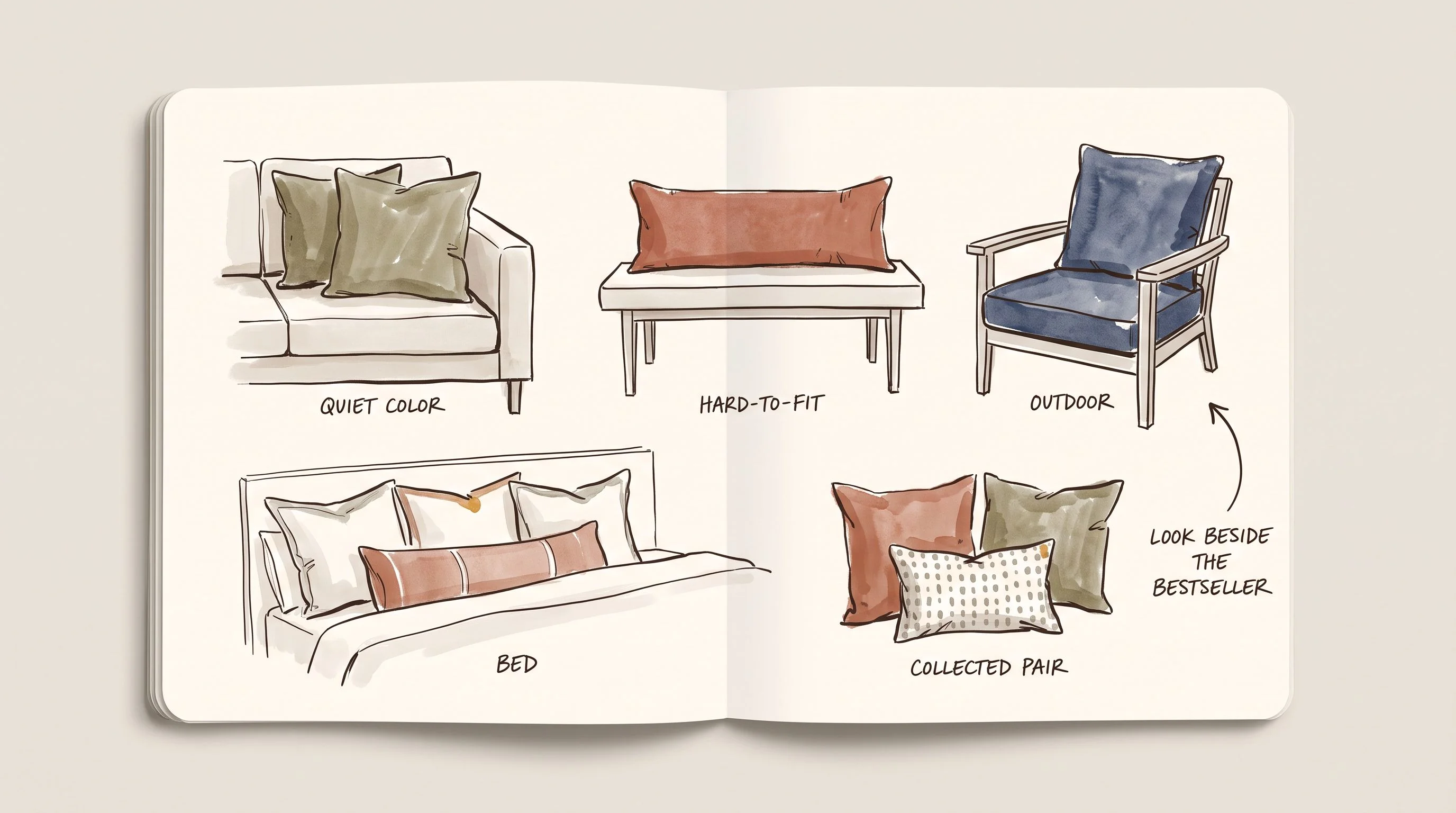
The most promising directions are not random new patterns. They are coherent points of view:
The quiet collection. Faded olive, sand, tobacco, and washed indigo for buyers who like rug geometry but not the loud red-and-orange version of boho.
The hard-to-fit collection. Long lumbar and bench covers presented in rooms where a square pillow looks obviously wrong.
The outdoor collection. Rug-inspired patterns on a genuinely outdoor-rated substrate for covered patios and balcony benches.
The bed collection. Coordinated Euro shams and lumbar covers sold as a finished arrangement rather than isolated pillowcases.
The collected pair. Two related patterns that look found over time without forcing the buyer to assemble the combination herself.
Notice what each idea contains: an aesthetic, a use case, and a constraint. "Boho pillow" is a category. "A pair of faded olive rug-pattern pillows for a neutral sofa" is a product brief.
The opportunity is the gap, not the pillow
There is a lazy version of this opportunity: take the bestseller's pattern, make it green, and undercut it by four dollars.
That is not research. It is tracing.
What is worth borrowing is the seller's underlying bet: keep the visual language people already want, remove a compromise they have learned to accept, and make the result available in the colors and dimensions their rooms require.
That same bet can produce very different products. One seller might go after muted palettes. Another might own extra-long bench sizes. Another might build coordinated sets for beds. Another might take the look outdoors. The opportunity is not a particular red pattern. It is the unserved combination of aesthetic, use case, and constraint.
Print on demand makes that opportunity unusually accessible. Current POD catalogs include pillows and pillowcases, so a seller can test rug-inspired artwork without stocking covers or learning to sew. AI mockups can put the idea into a believable room and get the listing off the ground quickly. The production barrier is low enough that the quality of the niche angle matters far more than the mechanics.
The title can use the language people actually search (kilim, Turkish, vintage-inspired, boho) while the description explains what the product is made from and how the pattern is produced. The title earns the visit. The description sets the expectation.
The difficult part is not getting a pillow online. It is finding a version the buyer can immediately place in her life. "Boho pillow" is forgettable. "A faded olive 20x20 pair for a cream sofa" has a customer waiting inside it.
Build a collection, not a lottery ticket
Even allowing for a healthy margin of error, this one chenille cover is a spectacular outlier. It appears to generate about 35% of the shop's current monthly revenue and more than a quarter of its estimated lifetime revenue.
You should pay attention to that. You should not build a plan that requires the same result.
The sane entry is a small, legible collection: perhaps three original patterns, two color stories, and the few sizes your production partner can deliver well. List the singles. Show the pairings. Learn which combination gets saved, clicked, and bought. Expand the winning color into a lumbar. Turn the winning pattern into a coordinated second design.
The bestseller also carries an Evergreen badge in the research data. That is more interesting than the late-summer color bump. Burnt orange may benefit when fall decorating begins, but a 35-month-old listing with steady sales is not surviving on October alone. It is attached to a year-round need: people keep buying sofas, moving homes, changing bedding, and deciding that one corner of the room looks unfinished.
That is the kind of demand a small shop can build on.
Not a trend you have to catch this week. Not a viral design you have to imitate before everyone else does. A durable visual appetite with specific, fixable points of friction.
And notice what the actual product is underneath all of it: a repeating pattern. The seller's entire outlier rests on one piece of rug-inspired surface design, applied to 48 sizes of the same object. If designing that pattern is the step that feels out of reach, it is the exact skill this next part teaches.
That estimated $62,000 is not a forecast. It is a signal: strong enough to make this niche worth examining, not strong enough to excuse a copy.
Enter when you can see a buyer the current listings serve poorly: the neutral-room buyer, the long-bench buyer, the outdoor buyer, the buyer who wants the old-world pattern without the old-rug texture.
The opportunity is not the pillow everyone can already see.
It is the compromise the customer is still being asked to make.