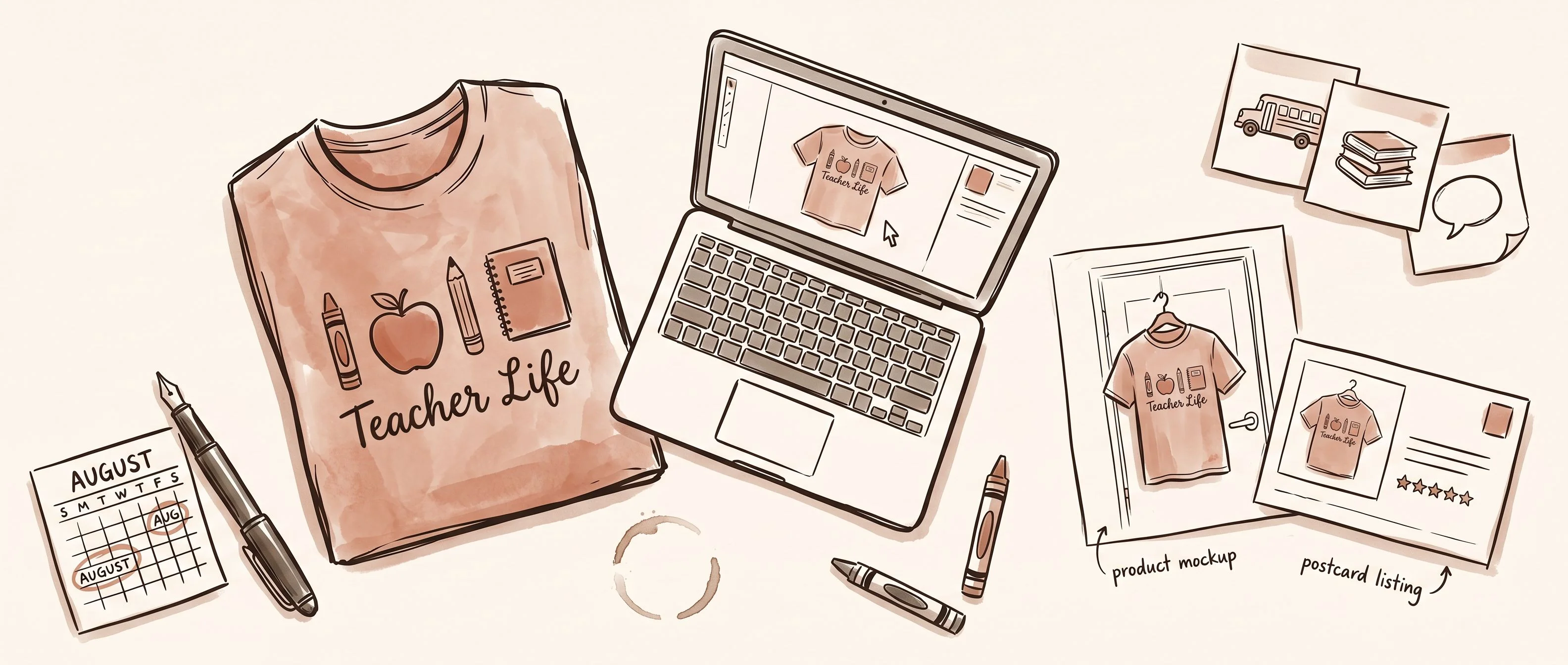
Picture the first staff meeting of the school year. Somewhere in a preschool hallway, a teacher walks in wearing a garment-dyed tee with a row of crayons, an apple, a pencil and a notebook across the chest, under the words Teacher Life. Two coworkers laugh. One asks where she got it. By lunch, three people have the link.
Now here's the part of that scene nobody pictures. The shirt didn't come from a brand. There's no warehouse, no screen-printing shop, no garage full of boxes. Somewhere on the other end of that Etsy listing is a person with a laptop who designed a graphic, uploaded it to a print provider, and never touched the shirt at all.
That scene is about to repeat itself tens of thousands of times, because back-to-school is the single most predictable gift wave on the calendar. And the honest question this post wants to leave you with isn't isn't that neat. It's why isn't one of those shirts yours.
The wave is already forming
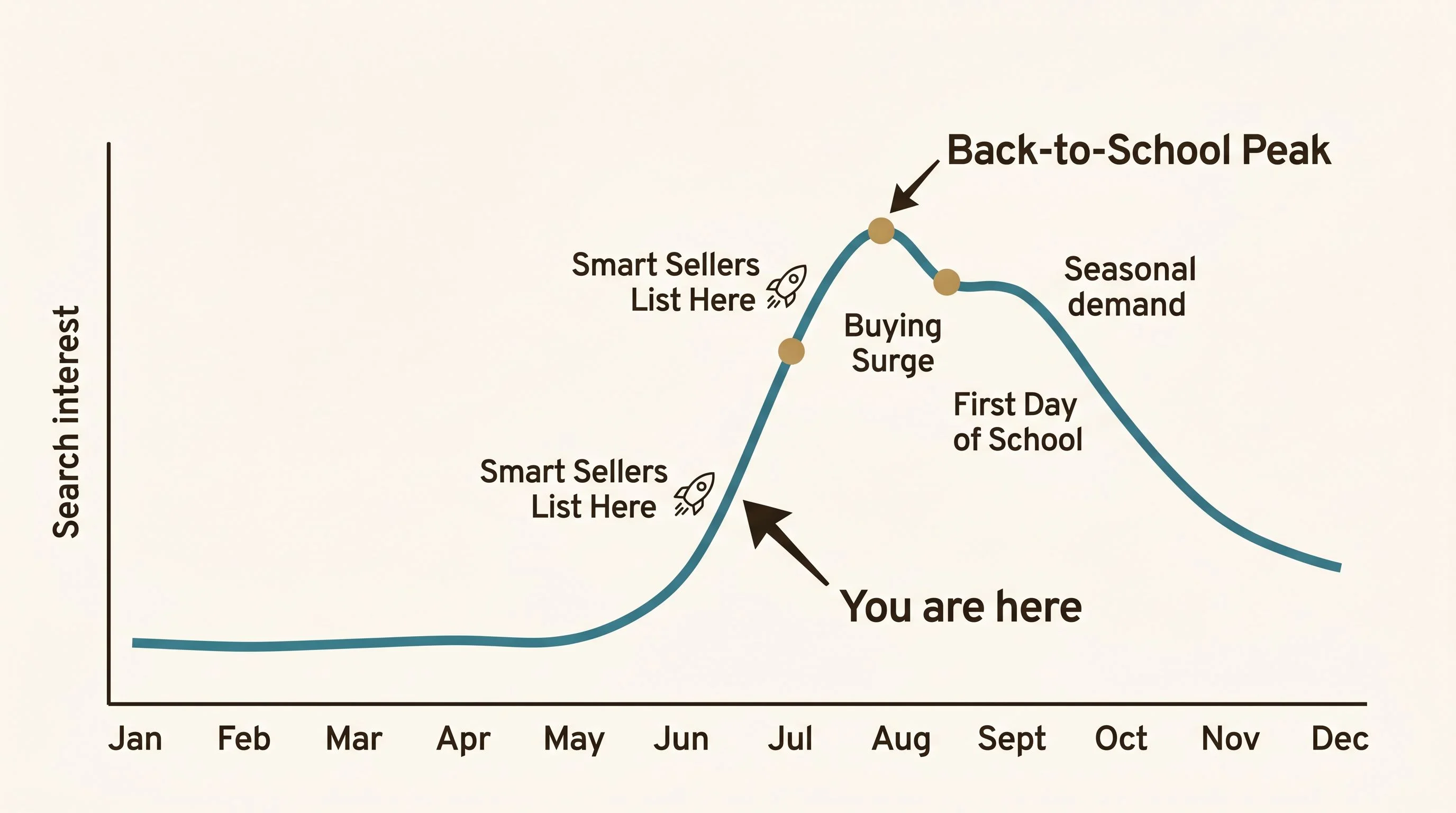
Back-to-school shopping on Etsy warms up in late July, surges through August, and peaks as classrooms open. It happens every single year, on schedule, like a tide chart. Parents buy teacher gifts, teachers buy themselves first-day outfits, and principals buy welcome-back swag for entire staffs.
The sellers who win this wave aren't the ones who notice it in August. They're the ones listing in June and July, while search volume is still low, so their listings have time to collect favorites and early sales before the flood arrives. We pulled apart one such listing this week: a funny teacher tee, barely a month old, already wearing a Bestseller badge before the season has even peaked.
That's not luck. That's a calendar. And right now, in early July, you're standing at exactly the right spot on it.
Why funny teacher shirts, specifically
Teacher shirts work because they sit at the intersection of three things buyers reliably pay for: identity, humor, and gifting. A funny teacher shirt isn't really apparel. It's a badge that says I survive twenty-six five-year-olds daily and I've kept my sense of humor about it. People buy identity for themselves and they buy it as gifts, which doubles the market for the exact same design.
The humor angle matters more than it looks. Sentimental teacher gifts are everywhere and they all blur together. Funny cuts through, gets photographed, gets asked about in the staff room, and gets reordered when a coworker wants one. The shirt markets itself in exactly the environment its buyers live in.
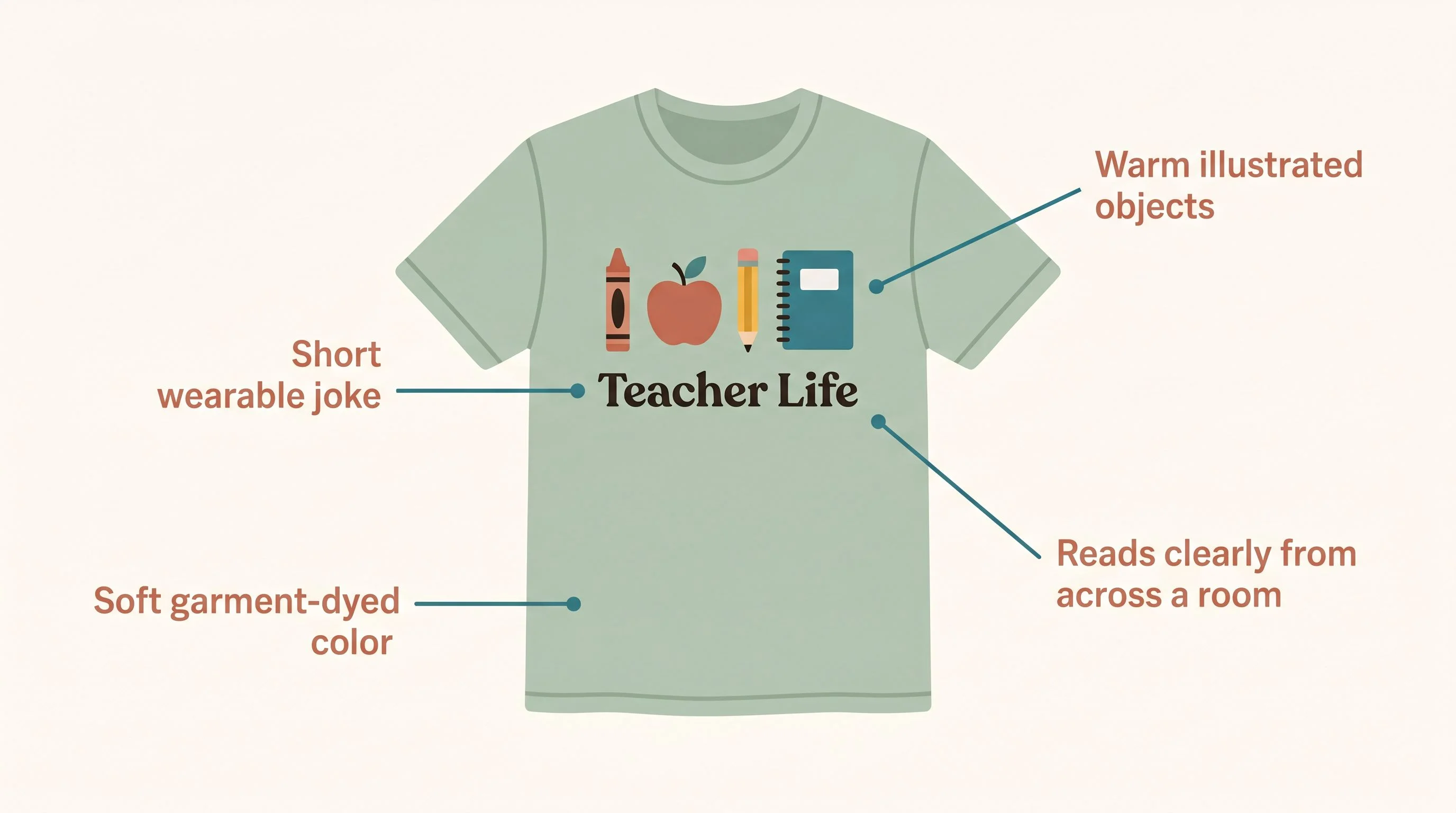
And the designs that win this niche aren't complicated. Warm illustrated school objects, a short wearable joke, soft garment-dyed colors. Look at what's selling and you'll notice the craft isn't in technical artistry. It's in matching a feeling to a role: preschool chaos, kindergarten glitter, the librarian's book stack. That's a research problem and a taste problem, not a drawing problem.
The specificity trick
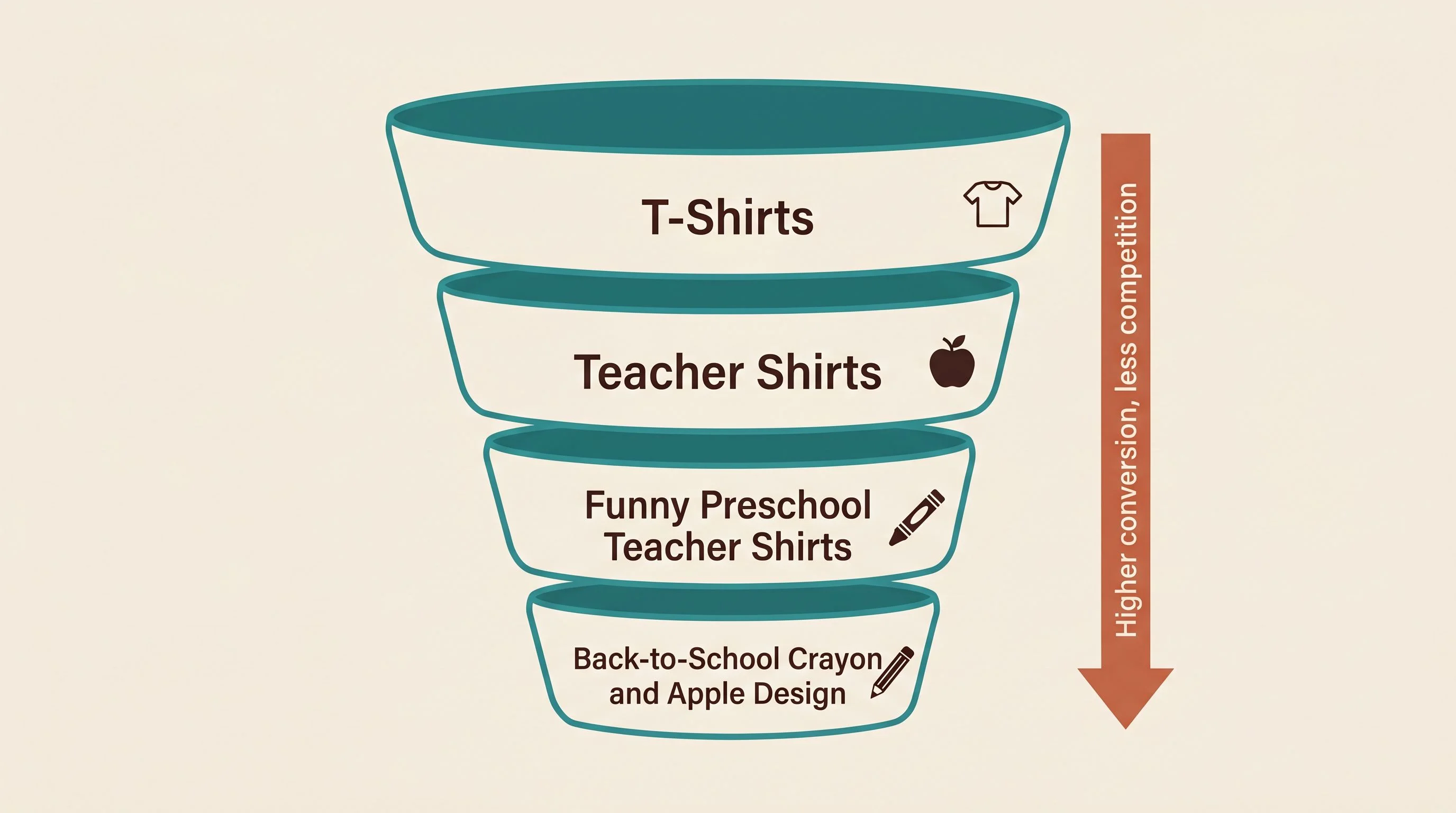
Here's where most people entering this niche go wrong: they make a shirt for "teachers." The winners never do. They make a shirt for preschool teachers, timed to back to school, in a funny register, on a Comfort Colors blank, and their titles say all of it.
Read a top title in this niche and you'll find four or five search intents stacked into one line: the blank brand for quality shoppers, the funny-teacher phrase for identity buyers, the back-to-school phrase for gift shoppers, and the sub-role to shed competition. Then a fifth, quieter move: describing the printed objects literally, crayon apple pencil notebook, to catch the buyer who saw one of these shirts on a coworker and is searching by memory of what was on it.
Each layer of specificity sheds thousands of competitors while the underlying buyer pool stays enormous. There are millions of teachers, and every one of them has a role, a grade level, and a start date. Specificity isn't limiting you. It's how you get found.
The back-to-school wave arrives on schedule every single year. The sellers who win it aren't more talented. They're just standing in the water in July while everyone else shows up in September.
No inventory, no drawing, no warehouse
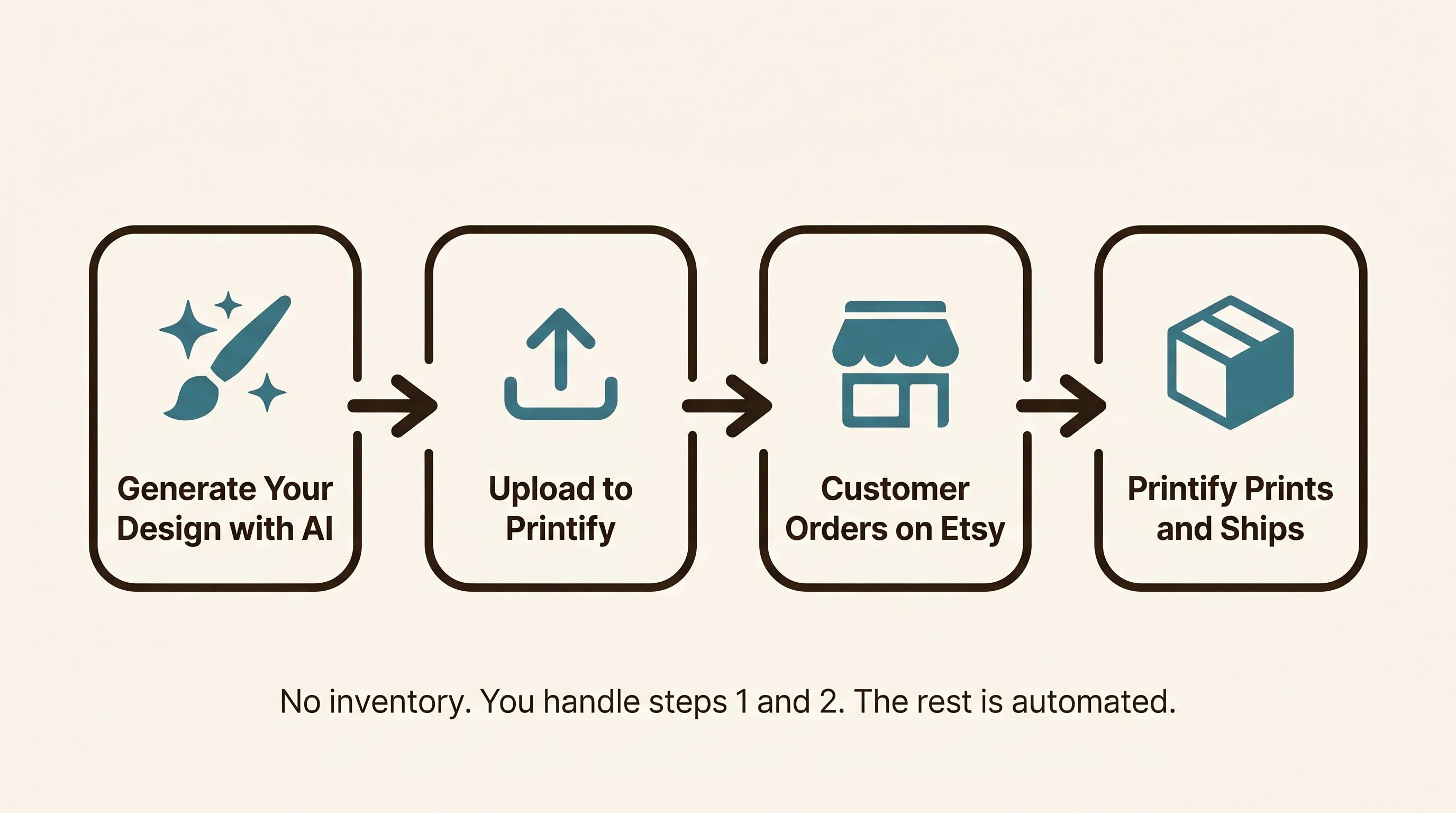
This is the part that used to be the barrier, and isn't anymore. These shirts are print-on-demand. You create a design and connect a provider like Printify to your Etsy shop. When a customer orders, the provider prints your design onto the blank, packs it, and ships it directly to her. You never hold a shirt. There's nothing to buy up front, nothing to store, and nothing to lose if a design doesn't sell except the listing fee.
The blanks themselves are part of the appeal. Providers on Printify carry the exact garment-dyed, ring-spun blanks this niche is built on, in more than a dozen colors, which means your shop can offer a full color range on day one without stocking a single unit.
And the design side has collapsed as a barrier too. A row of warm illustrated school objects with hand-lettered text is squarely within reach of current AI image tools plus an hour of cleanup. You describe the design, iterate until it feels right, and prep the file for print. The tools handle the rendering. What they can't handle is the judgment: which role, which joke, which moment on the calendar. That's your job, and it's the part that was always the real product anyway.
Where you enter
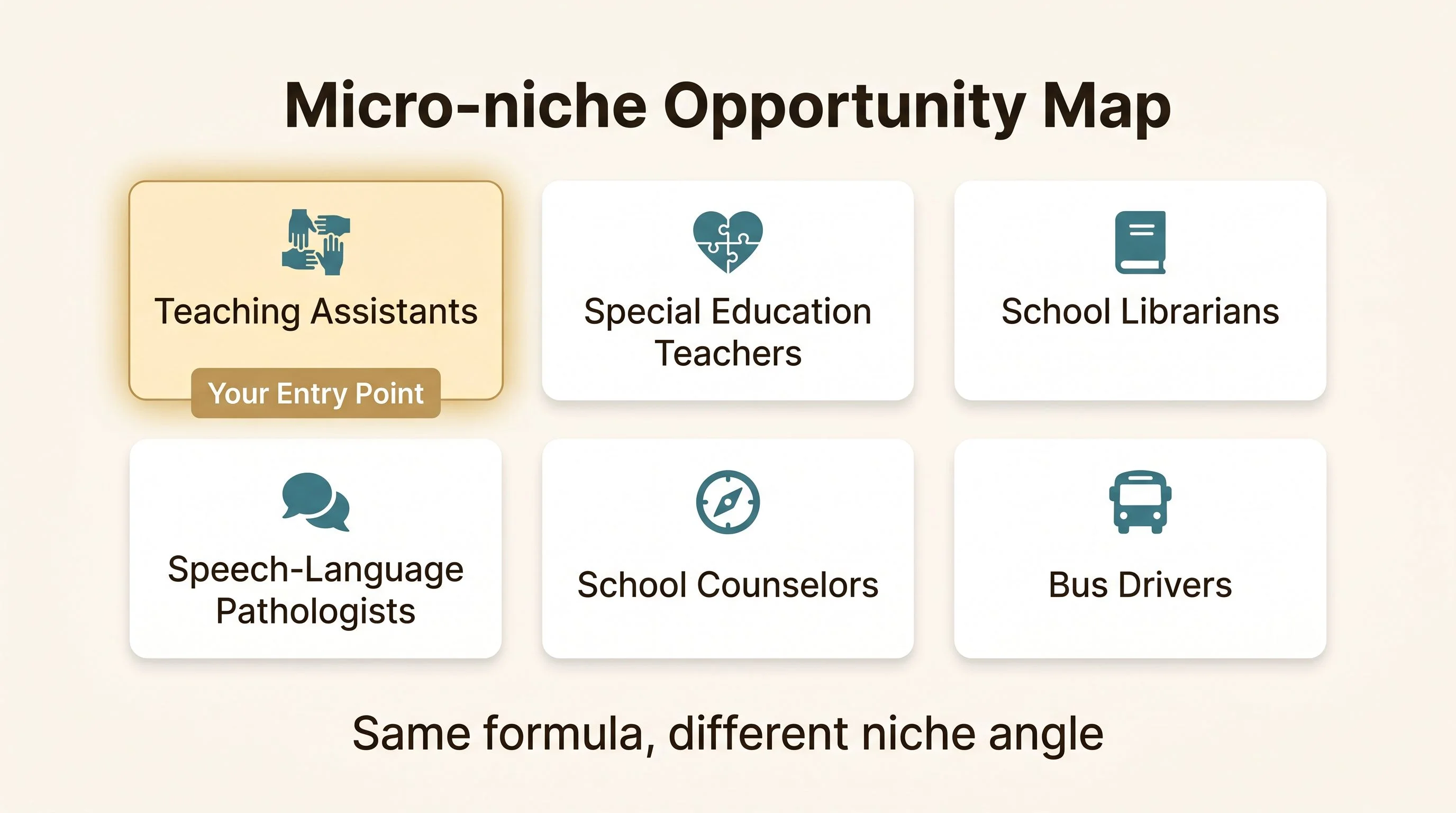
You don't need to fight the crowd on "funny teacher shirt." The same formula runs one lane over, where far fewer sellers have arrived. Paraprofessionals and teaching assistants get gifts constantly and have a fraction of the dedicated designs. Special education teachers, school librarians, speech-language pathologists, school counselors, lunch staff, and bus drivers all live inside the same August gift moment, and most of them are being served recycled generic-teacher designs that never name their actual role.
Pick one role. Learn its inside jokes from the communities where those people actually talk. Build three to five designs around the objects and phrases of that specific job, put them on quality blanks in a full color range, and write titles that name the role, the occasion, the blank, and the literal objects in the art.
Then list now, in July, and let the calendar do what it does every year.
Somewhere in August, a teacher is going to walk into a staff meeting wearing a shirt that makes her whole team laugh. Someone made that shirt from a laptop, without ever touching it. Pick your role, make your first five designs, and let that someone be you.