Most Etsy listings sell to one kind of person. This one sells to three, and they barely have anything in common.
There's the buyer hunting for a birthday gift for a dog-obsessed friend. There's the buyer who wants a piece of art for the wall that happens to feature their cat. And there's the buyer marking a pet they've lost. Three different moods, three different price tolerances, three completely different search terms, all landing on the same listing.
It has nearly thirteen thousand favorites, ten sales in the last day, and a perfect five-star rating across thousands of reviews. It looks like it's been around forever. The shop only opened in the summer of 2024. Listings like this one are doing the work of an entire business on Etsy right now, and the pattern behind why they work is worth understanding.
The timing is not the story, and that's the point
Most teardowns start with seasonality. A wreath print spikes in November, a beach towel design peaks in June, and the whole game is launching before the wave.
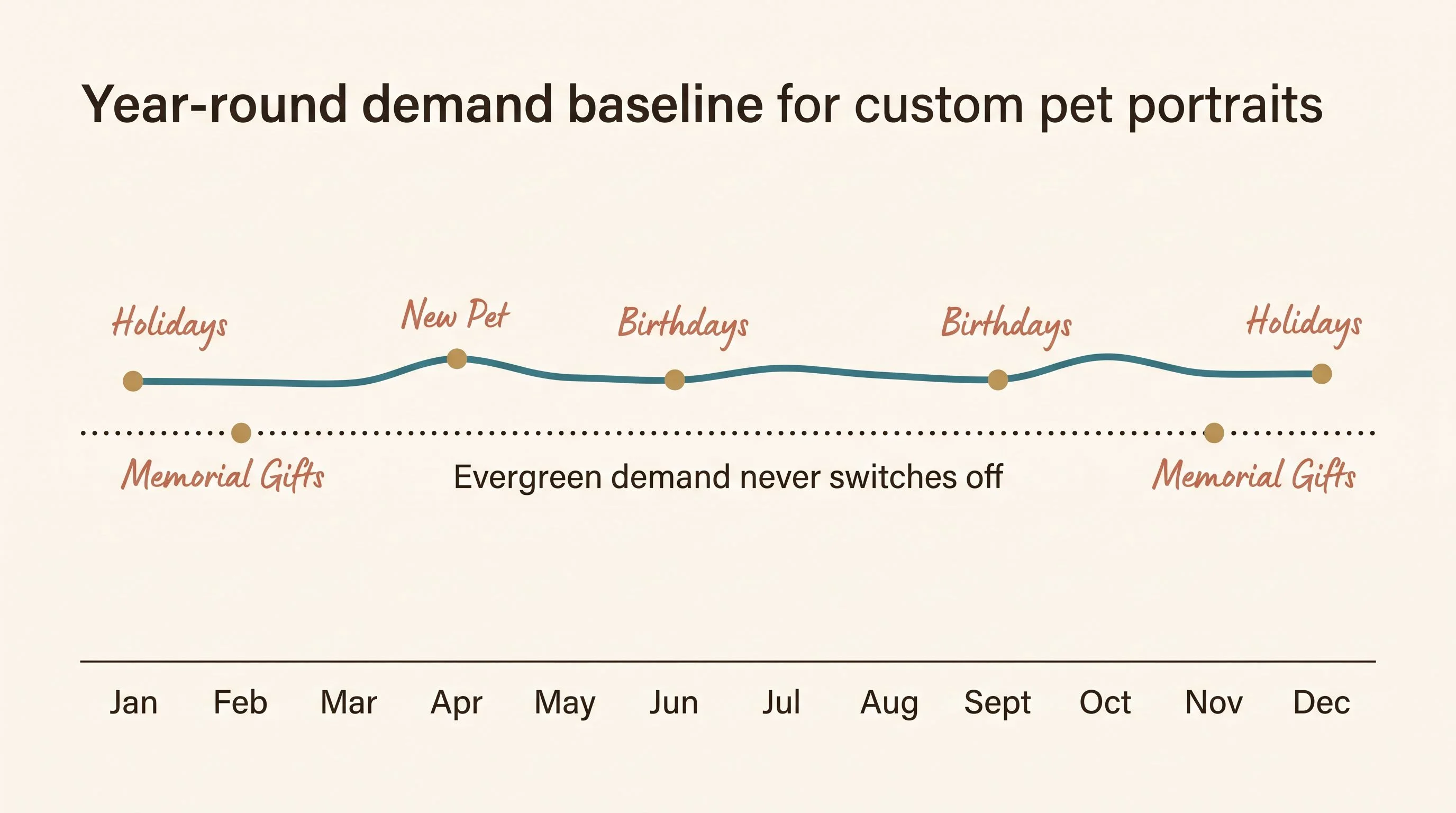
Pet portraits don't work that way, and that's exactly why this one is so strong. People don't buy a portrait of their dog because it's December. They buy it because they got a new puppy, because it's a birthday, because a friend's cat is their whole personality, or because they lost an animal they loved and they want something to hold onto. Those moments happen every single day of the year.
That's what evergreen actually means. Not "sells okay year-round" but "demand never switches off." There's no peak to miss and no dead season to survive. The trend line on this listing is gently up, month after month, because the reasons people buy are wired into ordinary life, not into the calendar. For a beginner, that's a gift. You can launch in February or August and the floor is the same.
The niche is three buyers wearing one coat
Look at the title and it reads like a keyword pile-up: watercolor, pet photo, digital, dog, cat, custom, memorial. Messy on the surface. Underneath, it's catching three completely different people with one listing.
There's the gift buyer, searching things like "fun gifts for dog owners" and "dog gift for partner." There's the decor buyer, looking for an "11x14 pet painting" to put on a wall. And there's the memorial buyer, the one typing "watercolor portrait for dog grief" or "cat memorial from photo" at the hardest possible moment. Three mindsets, one product, and the title is engineered to rank for all of them.
The memorial cluster is the quiet engine. It's the highest emotional intent and the lowest price sensitivity of the three. Someone buying a gift compares options. Someone honoring an animal they lost does not shop on price. Putting "Custom Pet Memorial Art" right in the title is the single sharpest decision in this whole listing.
And it's specific without being narrow. "Pet portrait" alone is a bloodbath of competition. This listing wins by sitting at the intersection of gift, decor, and memorial, broad enough for real volume but pointed enough to actually rank and convert.
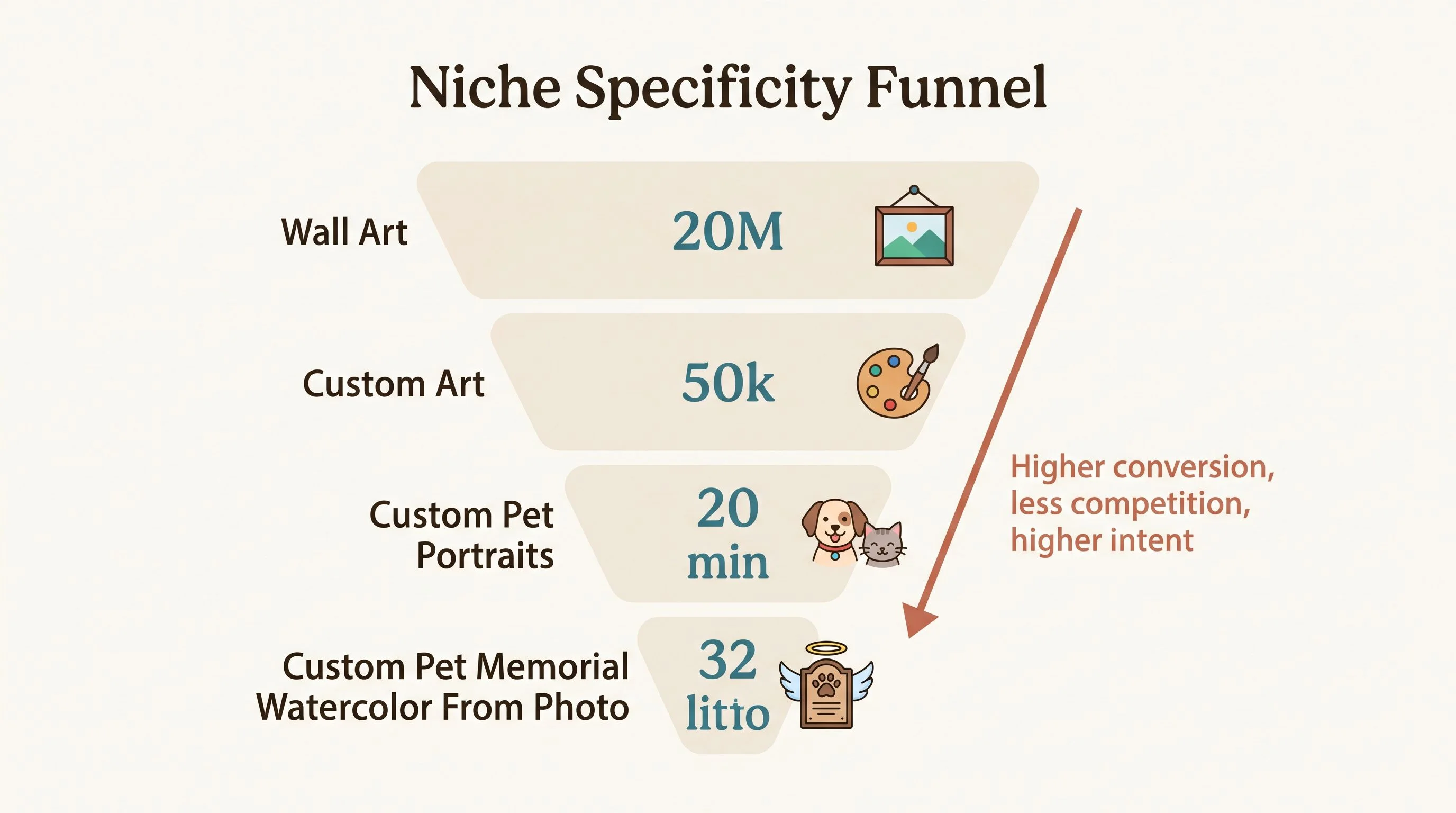
One product, three buyers, three different emotional reasons to click. The listing didn't pick a lane. It built a road wide enough for all of them.
The mockups are doing the selling
This listing carries ten images and a video, and for a custom product that image set is working overtime.
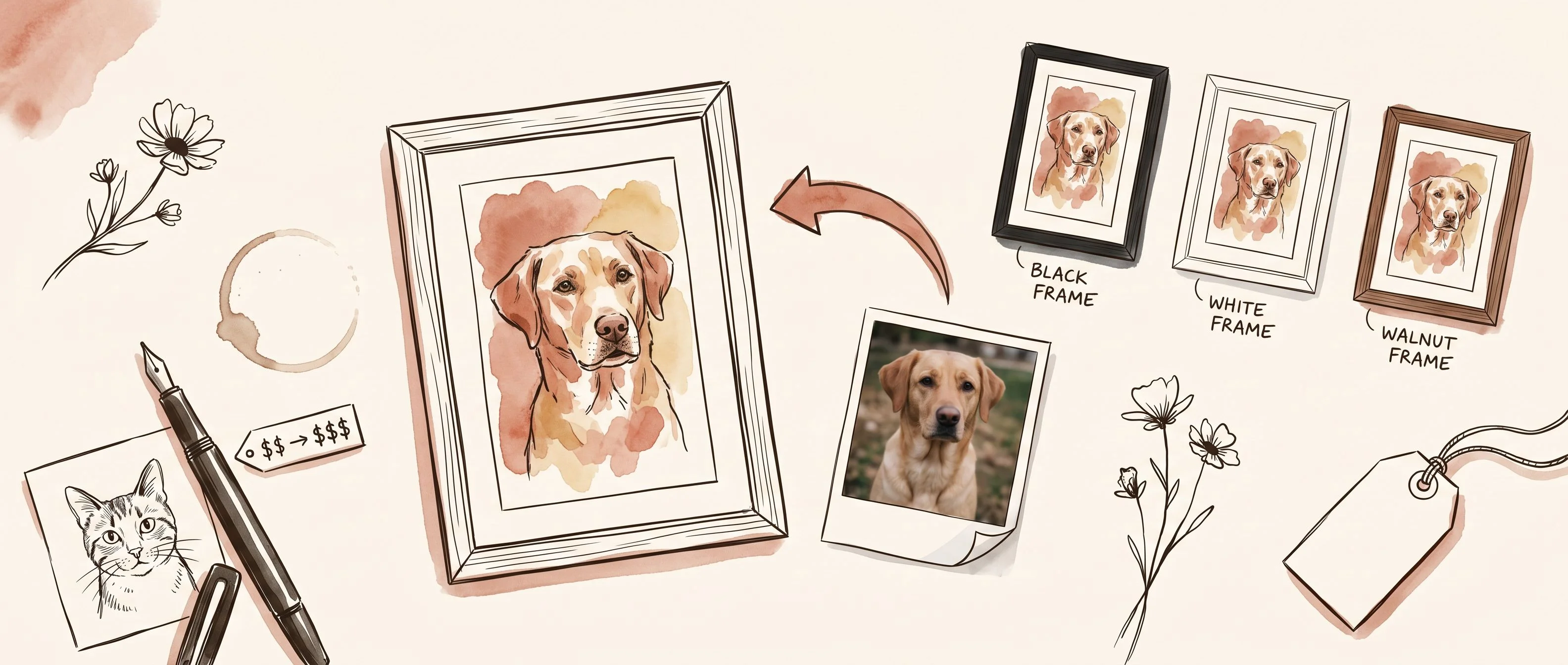
The smart move is showing the same art across every frame option, black, white, walnut, natural, in styled mockups. That's not decoration. Every framed mockup is quietly justifying the upsell from a cheap digital file to a hundred-dollar framed original. You don't have to argue the buyer up the ladder. You let them see the expensive version and want it.
For a made-to-order product, the images are also doing a second job: proof that the thing you'll get actually looks like your pet. Before-and-after photo-to-painting comparisons answer the only real objection a custom buyer has, which is "will this actually look like my dog." Show that you've answered it before they ask, and the sale gets a lot easier.
Where the AI spin comes in
Now here's where this gets interesting for you, because you don't need to be a watercolor painter to enter this niche.
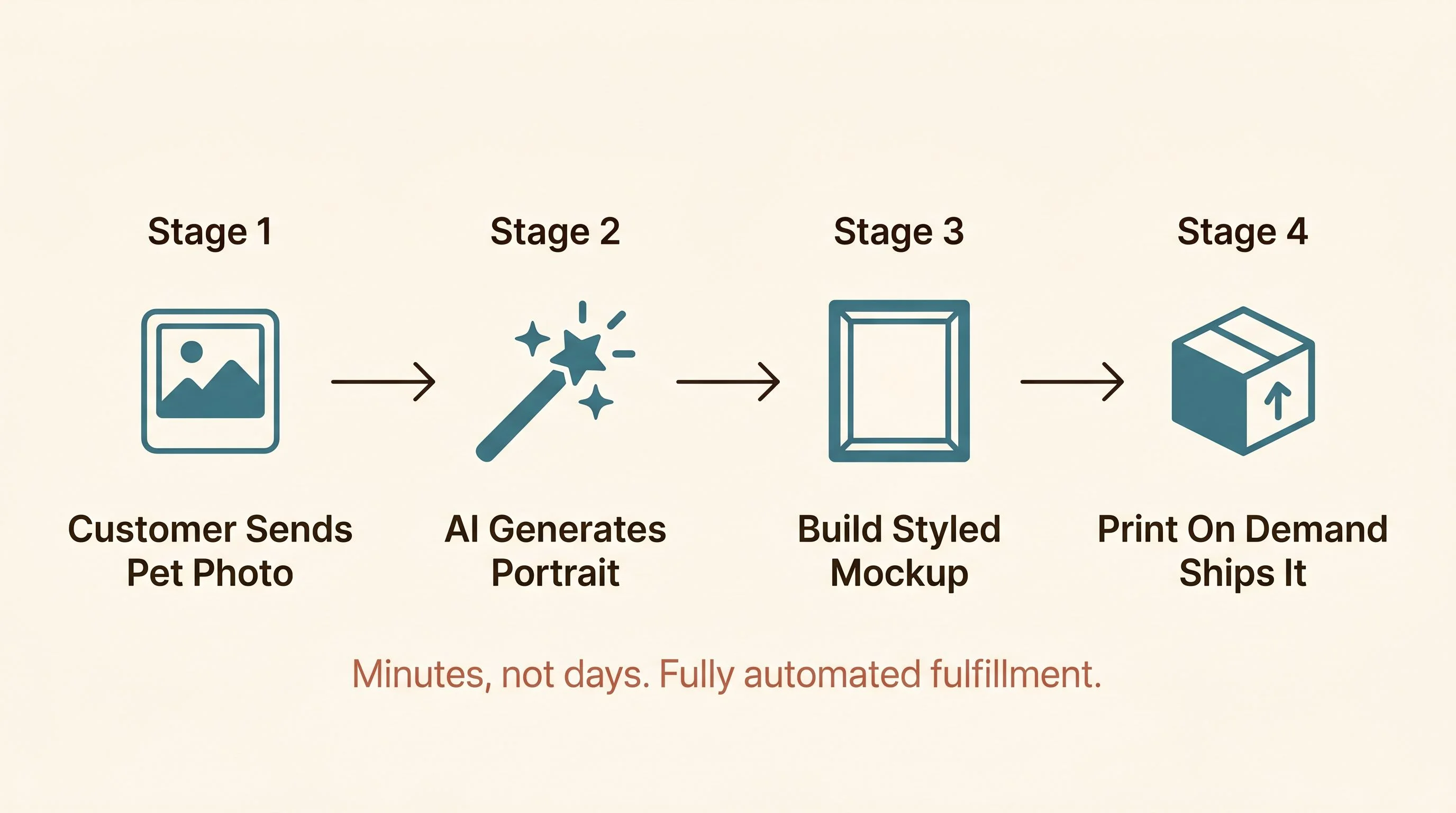
The original seller hand-paints, and that's a real moat for them. But the buyer's actual need isn't "a human held a brush." It's "a beautiful, personalized portrait of the animal I love, that looks like them, that I'm proud to hang." In 2026 you can deliver exactly that with an AI image pipeline, a customer's photo in, a clean stylized portrait out, in watercolor, line art, pop art, vintage, or storybook styles. What used to take days of painting now takes minutes, and the customer gets a faster turnaround on top of it.
That changes the math completely. The hand-painted version is capped by how many portraits one person can physically paint in a week. An AI-assisted version isn't. You can take volume the original can't, offer instant or next-day digital delivery, and still send the physical framed print through a print-on-demand partner so you never touch inventory. You handle the prompt and the customer photo. The fulfillment runs itself.
The play isn't to copy this listing. It's to take the proven demand, gift, decor, and especially memorial, and serve it with a pipeline that scales while theirs stays manual.
The operational polish most people skip
The unglamorous details are what separate a listing with twelve sales from one with thousands.
Look at what the reviews actually praise. Quality matters, but the single most-mentioned thing is the seller's communication. For a custom, emotional product, the proof-and-approval loop does as much selling as the art does. The buyer sends a photo, they see a draft, they approve it, they feel safe. That loop turns a risky custom purchase into a comfortable one, and it's the reason the reviews are five stars across the board.
Then there's the pricing ladder, and it's beautiful. The listing pulls you in at an impulse price for a digital file, less than a coffee. But the variations climb, more pets, larger sizes, framed originals, all the way up past three hundred dollars. The low number gets the click. The ladder captures the spend once the buyer is emotionally in.
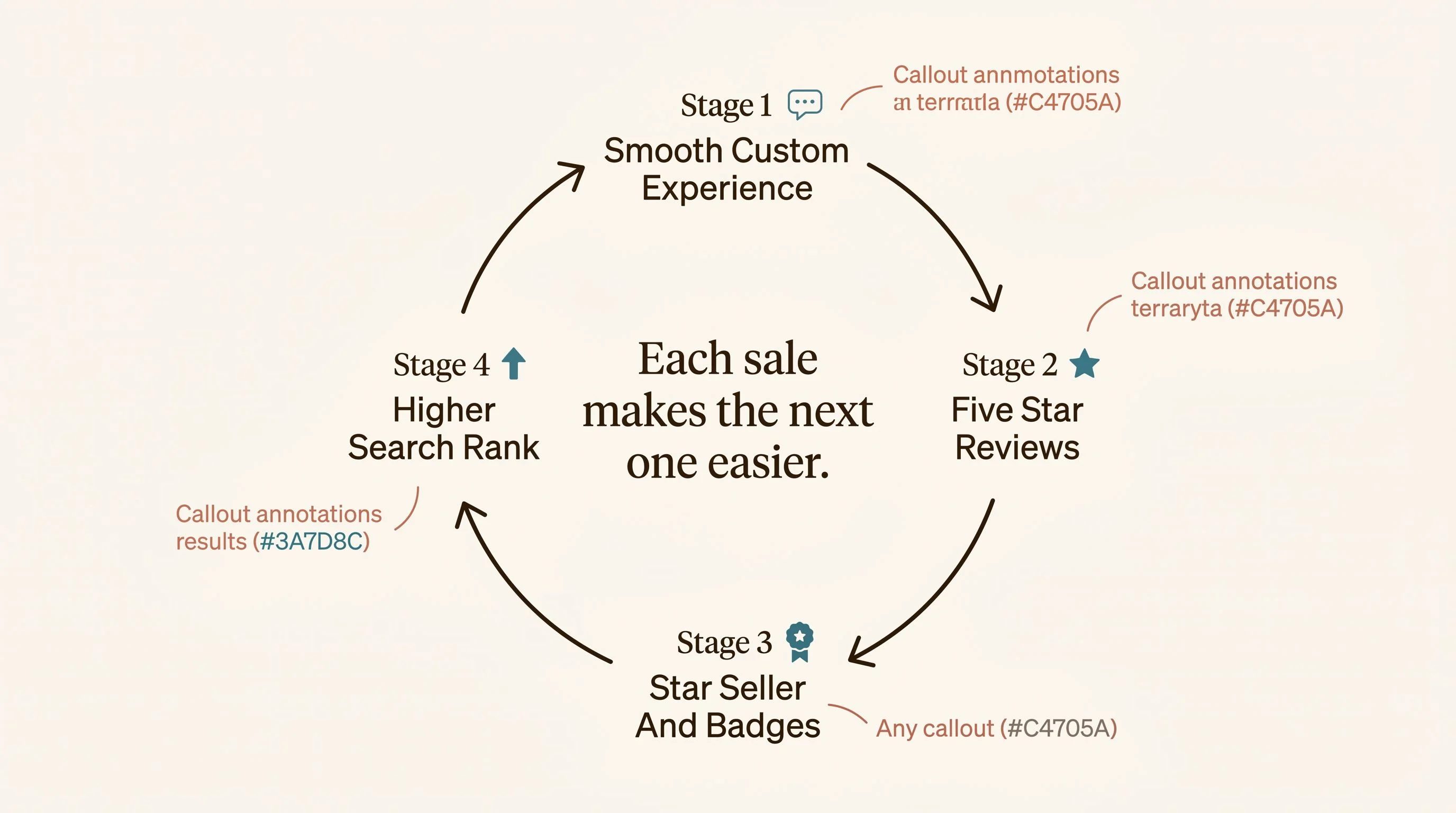
All of that feeds a loop you can't shortcut into existence. Friction-free experience produces five-star reviews. Reviews produce Star Seller and Etsy's Pick. Those badges produce higher search rank. Higher rank produces more sales, which produce more reviews. It compounds. After enough turns, a newcomer can't simply out-spend their way past it. That's how a listing barely two years old can end up carrying the majority of its shop's revenue.
Your micro-niche opportunity
You don't have to take "custom pet portrait" head-on. The smarter move is to take the same evergreen demand and angle it somewhere the giant listing isn't dominant.
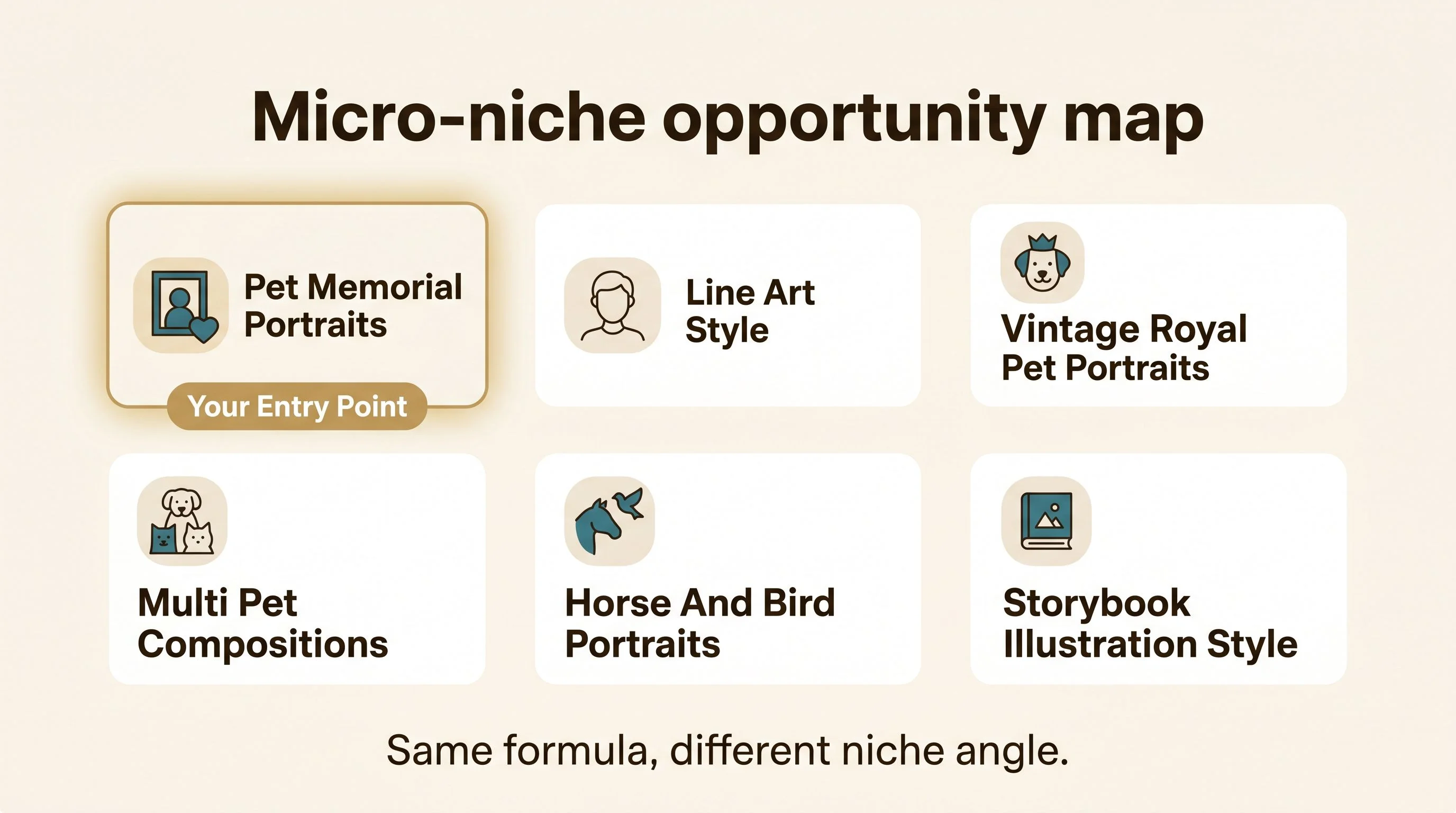
Lean hard into the memorial niche on its own, since it's the highest-intent buyer and most generalist listings treat it as an afterthought. Or pick a single style and own it: watercolor is crowded, but bold line-art portraits, vintage royal-pet portraits, minimalist single-line drawings, or storybook-illustration styles each have room. You could go species-specific, horse portraits and bird portraits and reptile portraits all have devoted, underserved owners. Or chase the multi-pet angle, the "all four of my dogs in one piece" buyer, which the click data shows people actively searching for.
Each of these uses the exact same machine: proven demand, custom personalization, an AI pipeline that delivers in minutes, mockups that justify the price ladder, and a clean approval loop. Same formula, different angle, far less competition.
None of the pieces here are hard on their own. Proven niche, clear buyer, a pipeline that does the heavy lifting, mockups that sell, an approval loop that builds trust. The reason almost nobody wins is that almost nobody does all of them together. The listings that do can carry a whole business off a single SKU.
Pick the angle the big listing ignores. Build one personalization pipeline that delivers in minutes. Make the mockups great, build a calm approval loop, and let the reviews start compounding. You don't need their two-year head start. You need one well-chosen angle done with the same intention you just watched.
— Nick, Second Stream Journal